Mattress Sizes and Dimensions

Written by Livvi DiCicco, Certified Sleep Science Coach
When it comes to mattresses, quality, performance, and comfort are crucial. But these aren’t the only things to consider when buying a new bed. Mattress size is just as important, if not a critical factor in determining whether a mattress feels comfortable for you.
Keep reading for a rundown of which sizes make the best mattresses for single adults, couples, teenagers, kids, toddlers, and babies. We even have details on the best mattress sizes for RVs, campers, and air mattresses!
Unsure of what size you need? Check out our video below to find out!
Standard Mattress Size Chart
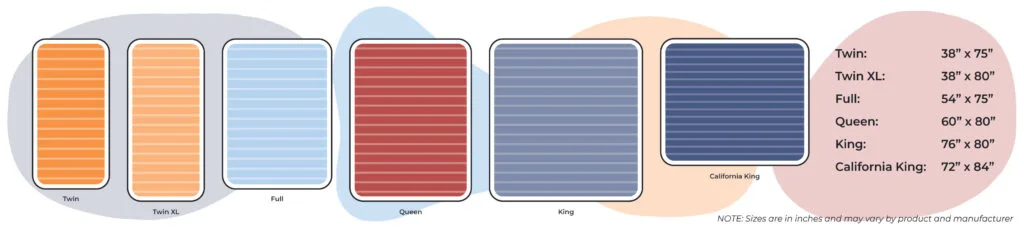
Here’s a helpful chart to help you visualize how big each type of mattress is.
| Size | Dimensions (in.) | Dimensions (cm.) | Best Bed Size For |
| Crib/Toddler | 28” x 52” | 71cm x 132cm | Infants and toddlers |
| Twin | 38” x 75” | 96.5cm x 190.5cm | Children, teens |
| Twin XL | 38” x 80” | 96.5cm x 203.5cm | Single adults, taller children |
| Full/Double | 54” x 75” | 137cm x 190.5cm | Children, single adults, couples, or people who share their bed with pets |
| Full/Double XL | 54” x 80” | 137cm x 203.5cm | Taller children, single adults, couples, or people who share their bed with pets |
| Queen | 60” x 80” | 152.5cm x 203.5cm | Single adults, couples, or people who share their bed with pets |
| Olympic Queen | 66” x 80” | 167.5cm x 203.5cm | Couples, single adults, and those who share the bed with pets who want extra room |
| King | 76” x 80” | 193cm x 203.5cm | Couples, families, or larger sleepers |
| California King | 72” x 84” | 183cm x 213.5cm | Couples, families, taller people, or larger sleepers |
| RV Mattress | Varies | Varies | RVs, campers, compact spaces |
| Air Mattress | Varies | Varies | Camping, sleepovers, guests, temporary sleeping arrangements |
Crib/Toddler Mattresses
- Crib Mattress Dimensions: 28” x 52”
The standard dimensions for a baby or toddler mattress are about 28 inches wide by 52 inches long. These mattresses are ideal for infants and toddlers who sleep in cribs.
When your child transitions from a crib into a toddler bed, you should be able to use the same mattress. Most children begin to transition to a “big-kid bed” around 18 months old, and this period can last until 36 months, depending on the child and the parents’ decision. One study shows that waiting until your child is 3 years old to switch can improve your child’s sleep quality and duration.
Babies and toddlers should sleep on a very firm surface. Studies show that firmer mattresses reduce the risk of Sudden Infant Death Syndrome (SIDS), while softer mattresses can increase the risk of suffocation.
Twin-Size Mattresses
- Twin Dimensions: 38” x 75”
- Twin XL Dimensions: 38” by 80”
The standard size of a Twin mattress is 38 inches wide by 75 inches long. Twin mattresses are best for children and teens, but adults may find these beds comfortable, too. They’re also good for toddlers who have transitioned into larger beds.
Adults might be more comfortable sleeping on a Twin XL mattress. They have the same width but give you five extra inches of length. They’re usually found in college dorms.
Full-Size Mattresses
- Full Dimensions: 54” x 75”
- Full XL Dimensions: 54” by 80”
Full mattresses are 54 inches wide by 75 inches long. Although not as common as Twin XL mattresses, you can also add some length by getting a Full XL bed, which is 54 inches wide by 80 inches long.
Also known as Double mattresses, Full mattresses are best suited to children and single adults. However, they can also work for some couples or single folks who sleep with pets in the bed.
Queen-Size Mattresses
- Queen Dimensions: 60” x 80”
- Olympic Queen Dimensions: 66” x 80”
Queen-size mattresses are 60 inches wide by 80 inches long. Or, you can opt for an Olympic Queen, which is 66 inches wide by 80 inches long.
Queen mattresses are an excellent option for teens, single adults, or people who sleep with their pets. Couples may also like Queen mattresses, depending on how much personal space you prefer.
King-Size Mattresses
- King Dimensions: 76” x 80”
Standard King-size mattresses are 76 inches wide and 80 inches long. They work well for taller people or anyone who wants room to stretch out. They’re also ideal for couples who don’t want to disturb one another when they toss and turn.
Split King Mattresses
- Split King Dimensions: two 38” x 80” beds (two Twin XL mattresses)
You might also consider a Split King mattress. These are two Twin XL mattresses placed side-by-side to create the approximate width of a traditional king. Two mattresses means you can have individual firmnesses, independent adjustment on bases, and enhanced motion isolation, which could appeal to some couples.
California King Mattresses
- California King Dimensions: 72” x 84”
- Split California King Dimensions: two 36″ x 84″ beds
California King mattresses have the reputation of being gigantic. But in reality, they’re four inches narrower than traditional King mattresses and only four inches longer. That said, they often serve the same purpose as regular Kings. However, they might be ideal for tall sleepers or if you have pets who sleep at the foot of your bed.
As you can with Split Kings, some brands do offer Split California King options, though these are quite rare, as they’re made of two specialty-sized beds rather than two existing mattress sizes (two Twin XL beds, for example, in a traditional split king).
RV Camper Mattresses
- RV Camper Dimensions: 28” to 35” x 75” to 79”
While you can probably get away with using a traditional mattress in an RV or camper, you might be better off getting a mattress designed for sleeping on the road.
RV mattresses range from 28 inches to 35 inches wide by 75 inches to 79 inches long. Many are often thinner to accommodate built-in bed frames or bunks. They’re usually lighter than standard mattresses, making them easier to move.
RV Mattress Size Chart
Here’s a helpful size chart to help you pick the right mattress dimensions for your RV or camper.
| RV Mattress Size | Dimensions (in.) |
| RV King | 72” x 80” |
| RV Queen | 60” x 80” |
| RV Short Queen | 60” x 75” |
| RV Full/Double | 53” x 75” |
| RV Three Quarter | 48” x 75” |
| RV Bunk | 28 to 35” x 75” to 80” |
| RV Truck | 35 to 42” x 79” to 80” |
| RV Twin | 28” x 75” to 80” |
Air Mattresses
- Dimensions: 38” to 76” x 75” to 84”
Air mattresses are great if you have guests staying overnight or want a comfortable place to sleep when you’re camping. They’re also helpful if you need a mattress in the interim, either when moving or waiting to buy a traditional mattress.
Air mattresses come in a wide range of sizes. You can find them in the same dimensions as Twin, Twin XL, Full, Double, Queen, King, or California King mattresses. Because of this, they can work for children, single adults, or couples.
The Best Mattress Size for Couples
Sleeping with a partner means you’re sharing the space, but how much extra do you really need? Here’s a rundown of the best mattress sizes for couples.
Queen
Queen mattresses can accommodate most adult couples. However, they might not be big enough if you also share your bed with pets or children.
King
King mattresses offer an ideal width to length ratio, making them a fabulous fit for couples. The downside is that they might be too large for certain spaces and are often more expensive than smaller options.
Still unsure on which to pick? Check out more about Queen vs King mattresses.
California King
California King mattresses are longer (but narrower) than regular King mattresses. This makes them ideal if you or your partner(s) are taller. But they might not be best if you want more width or if you share your bed with a partner and children. Moreover, some folks may have a harder time finding sheets for these beds, as it’s a less common size.
Check out all the differences in our discussion of California King vs regular King mattresses.
Split King
A Split King (or, in rare instances, a Split California King) mattress is another great option for those who share the bed. It’s essentially two mattresses pushed together to create one. This means you and your partner can each choose a firmness and feel that suits you best – no need for compromising.
It also means less motion transfer from one side to the other, since there’s separation between the mattress. You can even purchase an adjustable base for each side, which allows you to maneuver the head and foot on your side independently, all without disturbing your partner.
However, some split king beds are more expensive than their “regular” counterparts. And if you and your partner like to snuggle up, you might dislike the feeling of a gap between you.
For more tips on sleeping with a partner, check out our Couples Sleep Guide.
The Best Mattress Size for Single People
Single people rejoice! You can find comfort in a wide variety of mattress sizes. Plus, you don’t have to worry about buying a bed that suits a partner’s comfort needs.
Full
Full-size mattresses are a great option for children, teens, and adults alike. They’re more compact than King or Queen beds, so they’re easier to fit in smaller spaces. But if you’re taller or have a larger body mass than average, they might not provide enough space for your comfort.
Queen
Queen mattresses offer the best of both worlds. They’re larger than Full beds, but take up a lot less room than Kings. They also provide excellent surface area for single sleepers, so you have plenty of room to stretch out and roll around.
If you’re feeling too smushed up against your bedmate, whether it’s your partner, child, or a beloved pet, you may prefer an Olympic Queen. You don’t need as much space as you do with a King, but it offers a bit more width to spread out.
Still thinking? Check out our pros and cons of Full vs. Queen-size mattresses.
King
King-size mattresses can usually accommodate just about anyone, regardless of body size or height. However, they take up a lot of room and might be too big for children who sleep alone.
The Best Mattress Size for Children
Kids deserve a great mattress, too! Below, we’ll discuss the best-sized mattresses for children.
Full
A Full mattress provides an adequate amount of length and width for most children. But they might be too small for taller teens. They’re smaller than a Queen, so they should fit in smaller bedrooms. You can also comfortably fit a pet or another person in this bed for sleepovers.
Twin
Twin mattresses are ideal for kids transitioning from toddler beds to larger beds. They’re narrow, making them a good fit for smaller rooms. Most bunk beds are also built to accommodate Twin mattresses.
To help with your choice, check out our article on Twin mattresses vs Full mattresses.
Twin XL
Twin XL mattresses are a good option for teens or kids who are still getting taller. They’re quite prolific in college dorms, for example. But they might be a bit too big for young children just transitioning into larger beds.
Check out our article on Twin vs Twin XL mattresses if you’re struggling to pick between the two.
Factors To Consider Before Choosing a Size
Not sure what size bed you should get? Here are some important factors to keep in mind.
Who Shares the Bed
Consider how many people (or pets) will be sleeping in the bed each night. If you and your partner like to spread out, you may want to opt for a Queen over a Full. And if you have kids that like to crawl into bed, a King might be even better.
How Much You Move Around
If you’re an active sleeper who tosses, turns, rolls around a lot, you may want a larger bed. This reduces the risk of falling off the bed in the middle of the night. Plus, if you share a bed with someone, you’ll be less likely to disturb their sleep if there’s extra room.
Body Type
You might be more comfortable in a larger mattress if you’re tall or if you have an above-average body mass. As mentioned, California King beds are best for taller folks because of their added length. Conversely, Olympic Queen beds have more width, and could make for some of the best beds for heavy people.
Bedroom Dimensions
Be sure to measure the size of the bedroom before you buy a new bed. This will help you determine the ideal mattress for your space.
Budget
You can find a high-quality mattress at almost any price point. But, generally, larger beds are more expensive than smaller beds. A Full mattress is probably the cheapest mattress size that can accommodate two sleepers, but note that you’ll likely be in close quarters.
What to Consider When Purchasing a Mattress
When buying a new bed, deciding on a mattress size is an important first step. It’s important to consider how many people will share the bed and how much you’ll want to spread out.
Generally, a Queen mattress is the most versatile bed for single-sleeper adults and couples alike. Still, they might be a bit too big for kids who would probably be more comfortable on a Twin, Twin XL, or Full-size bed. You may also prefer a King or California King mattress if you like extra space when you sleep or if you share a bed with a partner.
Aside from considering your personal space needs, be sure to measure your room before you pull the trigger on a new mattress. While a big bed can be great, it might not suit your suite.
Once you’ve figured out the perfect size, you can consider other important factors like cost and feel. Then, you’re on your merry way to a revamped sleep system.
Mattress Sizing FAQs
Can two people share a Full-size bed?
Yes, but some people might not be comfortable sharing a 54-inch wide bed with someone else every night. There’s less space than a Queen-size mattress, the most popular option in the United States for co-sleepers. According to our study, people that have a King-size mattress are the most satisfied sleepers.
What is a California King mattress?
A California King mattress is longer but narrower than a standard King-size mattress. A California King is 72 inches wide by 84 inches long while a normal King is 76 inches wide by 80 inches long. They’re ideal for taller individuals, or for those who have pets who sleep on the foot of the bed.
Is there a difference between Twin XL and Full-size mattresses?
A Twin XL mattress measures 38 inches wide and 80 inches long, and a Full bed mattress measures 54 inches wide and 75 inches long. For taller, thinner teenagers and young adults who will be sleeping alone, a Twin XL can provide a comfortable sleep experience. For larger teenagers or young adult couples, a Full-size mattress will likely be the better option.
What’s the most popular mattress size?
Queen mattresses – which are 60 inches wide by 80 inches long – are the most common mattress size purchased. They’re arguably the most versatile mattress for adults and can be used for single sleepers, couples, and people who share their bed with pets or kids.
Is there a difference between Twin and Single mattresses?
A single-size mattress measures 30 inches wide by 75 inches long, while a twin mattress is 38 inches wide by 75 inches long. Twin mattresses are better suited for larger children who need extra room and personal space while they sleep.
What are standard mattress sizes?
Below, you’ll find an overview of the most common standard mattress sizes in the United States:
- Crib/toddler: 28” x 52”
- Twin: 38” x 75”
- Twin XL: 38” x 80”
- Full/Double: 54” x 75”
- Full/Double XL: 54” x 80”
- Queen: 60” x 80”
- Olympic Queen: 66” x 80”
- King: 76” x 80”
- California King: 72” x 84”
You can also get an air mattress that ranges from 38” to 76” x 75” to 84”, or an RV/camper mattress, which ranges from 28” to 35” x 75” to 79”.
Source List
- Williamson, A. A., Leichman, E. S., Walters, R. M., & Mindell, J. A. (2019). Caregiver-perceived sleep outcomes in toddlers sleeping in cribs versus beds. Sleep Medicine, 54, 16–21. https://doi.org/10.1016/j.sleep.2018.10.012
- Gillani, S. H., Lowell, G. S., & Quinlan, K. P. (2021). A firm recommendation: measuring the softness of infant sleep surfaces. Injury Epidemiology, 8(S1). https://doi.org/10.1186/s40621-021-00325-x
- Wiggermann, N., Smith, K., & Kumpar, D. (2017). What Bed Size Does a Patient Need? The Relationship Between Body Mass Index and Space Required to Turn in Bed. Nursing Research, 66(6), 483–489. https://doi.org/10.1097/nnr.0000000000000242